


Every second your ecommerce website takes to load, you lose money.
Not traffic.
Money.
In ecommerce, speed is not a technical detail. It’s a conversion factor.
For small businesses in the USA competing against Amazon-level performance expectations, even a slight delay affects trust, engagement, and checkout completion.
If your store feels slow, customers assume risk.
And risk kills sales.
This guide explains how ecommerce website speed optimization works, why it directly affects revenue, and what small business owners must prioritize in 2026.
Why Speed Matters More for Ecommerce Websites
A blog loading slowly is frustrating.
An ecommerce store loading slowly is expensive.
According to Google research, as page load time increases from 1 to 3 seconds, the probability of bounce increases dramatically. Page experience signals are part of how Google evaluates performance.
For ecommerce, slow performance impacts:
- Product page engagement
- Add-to-cart rates
- Checkout completion
- Mobile conversions
- Search rankings
Speed influences both user psychology and algorithmic ranking.
That’s why ecommerce website speed optimization is not optional.
It is revenue infrastructure.
How Website Speed Impacts Ecommerce Revenue
Let’s break this down practically.
Imagine your store receives 5,000 visitors per month.
If your site converts at 2%, that’s 100 sales.
Now imagine speed improvements increase conversions to 2.6%.
That’s 130 sales.
Same traffic.
30% more revenue.
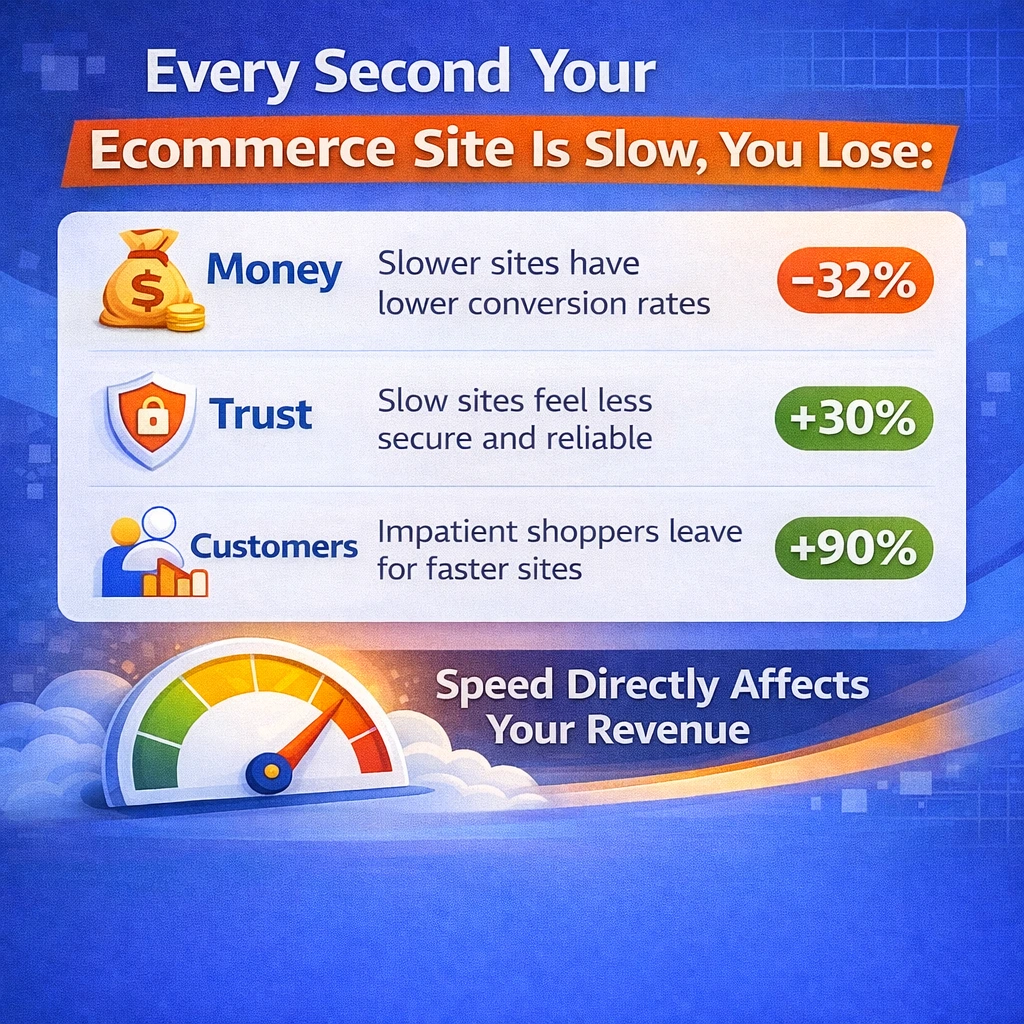
Speed does not just reduce bounce rates. It increases buyer confidence.
Customers subconsciously associate fast sites with secure, professional businesses.
Slow sites create doubt.
In competitive US markets, doubt sends users to competitors instantly.
Core Areas of Ecommerce Speed Optimization
Speed optimization is not one single fix.
It’s a system of technical improvements.
Key areas include:
- Server response time
- Image compression and modern formats
- Code minification
- JavaScript optimization
- Database efficiency
- CDN implementation
- Mobile responsiveness
- Caching configuration
Each layer contributes milliseconds.
Milliseconds compound.
And compounded milliseconds affect conversions.
Core Web Vitals and Ecommerce
Google’s Core Web Vitals measure:
- Largest Contentful Paint (LCP)
- Interaction responsiveness
- Visual stability
These are not abstract metrics. They reflect real user experience.
Google provides detailed documentation explaining how these metrics affect performance evaluation.
If product pages load slowly or shift visually during checkout, trust erodes.
Optimizing ecommerce speed means improving these measurable performance signals.
Ecommerce Speed vs Regular Website Speed
Ecommerce websites are heavier.
They include:
- Product images
- Payment gateways
- Cart scripts
- Tracking pixels
- Third-party integrations
- Dynamic content
This complexity makes optimization more technical than a standard brochure website.
That’s why ecommerce speed requires specialized handling.
Businesses working with structured platforms like Rydesk often integrate development and optimization together instead of treating speed as an afterthought.
Common Speed Killers in Ecommerce Stores
Here are the most frequent problems we see in small business ecommerce sites:
- Oversized product images
- Too many unoptimized plugins
- Cheap shared hosting
- Bloated themes
- Excessive third-party scripts
- Unoptimized checkout pages
Most store owners never realize these are silently hurting sales.
Speed degradation happens gradually.
Revenue decline follows.
Measurable Impact of Speed Optimization
Here’s how performance typically changes after structured optimization:
Before Optimization | After Optimization |
4–6 second load time | 1.5–2.5 second load time |
High mobile bounce rate | Improved mobile engagement |
Inconsistent checkout flow | Stable checkout experience |
Low conversion rate | Higher cart completion |
Ranking instability | Improved SEO stability |
Speed improvements compound across SEO and conversion channels.
Mobile Speed: The Critical Factor
More than half of ecommerce traffic in the USA comes from mobile devices.
Mobile networks are less stable than desktop broadband.
If your ecommerce store is not optimized for mobile speed:
- Pages stall
- Images delay
- Checkout freezes
- Users abandon
Mobile-first optimization is now the baseline.
Not an upgrade.
DIY Speed Optimization vs Professional Implementation
Some speed improvements are basic.
Many are not.
True ecommerce speed optimization requires:
- Server-level configuration
- Code restructuring
- Performance testing tools
- Script deferment logic
- Resource prioritization
Professional Website Speed Optimization Services focus on identifying bottlenecks and systematically improving performance across all layers.
Instead of guessing, the approach is data-driven and performance-tested.
That difference matters when revenue depends on milliseconds.
Signs Your Ecommerce Website Is Too Slow
You don’t always need a tool to notice.
Warning signs include:
- Product pages taking more than 3 seconds to load
- Checkout page delays
- Mobile pages feeling heavy
- High bounce rate in analytics
- Low add-to-cart rates
If these patterns appear, speed is likely costing you sales.
The Competitive Advantage of Fast Ecommerce Sites
Speed is invisible when done right.
But its impact is measurable.
Fast ecommerce sites:
- Rank more consistently
- Convert more effectively
- Reduce abandonment
- Build customer trust
In US ecommerce markets, customers expect Amazon-level performance.
Small businesses that ignore speed lose simply because competitors load faster.
That’s not a marketing problem.
That’s a performance problem.
Final Thoughts
Ecommerce website speed optimization is not cosmetic.
It’s structural.
It affects:
- Revenue.
- SEO performance.
- Customer trust.
- Brand perception.
If your store is slow, marketing campaigns won’t fix the root issue.
Traffic without speed is wasted opportunity.
Optimizing speed ensures every visitor has the best chance to convert.
For small businesses serious about scaling ecommerce revenue in 2026, performance optimization is no longer optional.
It’s foundational.
Frequently Asked Questions
What is ecommerce website speed optimization?
It is the process of improving load times, responsiveness, and performance metrics specifically for online stores to increase conversions and SEO performance.
Does website speed affect ecommerce sales?
Yes. Faster websites improve user experience, reduce bounce rate, and increase checkout completion rates.
What is a good load time for an ecommerce site?
Ideally under 2.5 seconds for primary pages, especially product and checkout pages.
Can slow speed hurt Google rankings?
Yes. Google considers page experience and performance signals when evaluating rankings.
How often should ecommerce websites be optimized?
Performance should be monitored continuously, with optimization reviews conducted regularly to maintain peak speed.