


Quick Summary
Aspect | Key Takeaway |
Core Models | Two-tier (simple), three-tier (enterprise standard), microservices/headless (modern scalable) |
5-Layer Framework | Presentation → Business Logic → Core Commerce → Best-in-Breed Apps → Third-Party Middleware |
Deployment Choice | SaaS for speed (Shopify Plus), PaaS for custom flexibility, On-Premises for compliance/control |
SEO Priority | Silo URL structure, faceted navigation control, server-level Core Web Vitals optimization |
Database Strategy | Hybrid SQL + NoSQL schema, read replicas, sharding at high transaction volume |
Critical Pitfall | Tight coupling and chatty APIs that block scalability and crawl efficiency |
A high-performing storefront is never an accident. Behind every fast-loading, highly-converting online store sits a deliberate ecommerce website architecture – a blueprint that dictates how data flows between your frontend, backend, and third-party services.
Get this blueprint wrong, and you inherit database bottlenecks, sluggish API payloads, and a site structure that search engines struggle to crawl. Get it right, and you build a platform that scales with traffic spikes, ranks on merit, and survives a decade of feature additions without a full rebuild. Given how much technical nuance is involved at every layer, many growing brands choose to hire ecommerce developer expert support early, rather than retrofitting architecture decisions after launch.
This guide breaks down ecommerce website architecture from legacy two-tier systems through the modern 5-layer enterprise framework, covering the deployment models, SEO mechanics, and failure points every developer and technical stakeholder needs to understand in 2026.
What is Ecommerce Website Architecture and Why Does It Matter?

Ecommerce website architecture is the structural framework that governs how a storefront’s presentation layer, business logic, data storage, and third-party integrations communicate. It defines where computation happens, how data decoupling occurs between systems, and how requests travel from a customer’s click to a rendered page.
A weak architecture typically shows the following symptoms:
- High latency – every page request triggers multiple synchronous database calls instead of using cached or pre-computed responses.
- Database bottlenecks – a single monolithic database handles catalog reads, order writes, and session data simultaneously, creating lock contention under load.
- Poor crawlability – bloated DOM structures, render-blocking JavaScript, and inconsistent URL hierarchies prevent search engines from efficiently indexing product pages.
- Tight coupling – a UI change requires touching backend code, slowing down release cycles and increasing regression risk.
A robust, SEO-driven architecture flips each of these:
- Static and semi-static content (category pages, blog content) is served from edge caches or a CDN, reducing time-to-first-byte.
- Read-heavy operations (catalog browsing) are separated from write-heavy operations (checkout, inventory updates) using distinct data stores or read replicas.
- URL structures map cleanly to a logical site hierarchy, supporting clean crawl paths and topical silos.
- Frontend and backend evolve independently through versioned APIs, with load balancers distributing traffic evenly across application instances.
The architectural decisions made at the foundation directly determine your Core Web Vitals scores, crawl budget efficiency, and conversion rate – making this far more than a backend concern. Before any code is written, working through a structured ecommerce website development checklist helps teams catch these risks at the planning stage rather than discovering them post-launch.
Evolution of Frameworks: From Legacy to Modern Systems

Ecommerce platforms have evolved through three distinct architectural generations. Understanding this progression clarifies why modern enterprises are migrating away from monolithic systems toward distributed, API-first stacks.
1. Two-Tier Architecture (Simple but Restrictive)
In a two-tier model, the client (browser) communicates directly with the server, which handles both the application logic and the database queries in a single tier. This is the purest form of monolithic architecture – everything lives in one deployable unit.
This structure is fast to deploy and simple to maintain for small catalogs, but it creates a critical limitation: the presentation layer and business logic are fused together. Any change to the storefront design risks destabilizing checkout logic or inventory rules, since they live in the same codebase, and scaling means replicating the entire stack rather than just the bottlenecked component.
Attribute | Two-Tier Reality |
Deployment speed | Fast |
Scalability ceiling | Low – vertical scaling only |
Customization flexibility | Limited |
Best fit | Small catalogs, low traffic, MVPs |
2. Three-Tier Architecture (The Enterprise Standard)
The three-tier architecture separates concerns into three independent layers, each of which can be scaled, secured, and updated separately:
- Presentation Layer – the UI/UX layer rendering HTML, CSS, and client-side JavaScript that the customer interacts with directly.
- Business Logic Layer – the application server processing cart rules, pricing logic, tax calculations, and order workflows.
- Data Layer – the persistent storage layer (typically a relational SQL database) holding product, customer, and order records.
This separation is what makes horizontal scaling possible – you can add more application servers behind load balancers without touching the database layer, and vice versa. It became the de facto enterprise standard because it isolates failure domains: a spike in checkout traffic doesn’t necessarily crash your CMS layer.
Real-world scenario: A mid-sized B2B distributor running Magento (Adobe Commerce) is a textbook three-tier monolithic deployment. Magento bundles presentation templates, business logic (pricing rules, B2B quoting), and the MySQL data layer into one cohesive platform. This fits a business with a moderate catalog size, predictable traffic patterns, and complex quoting or tiered-pricing requirements – which is exactly the scale where partnering with a dedicated b2b ecommerce development agency tends to pay off, since these builds demand deeper customization than a typical SaaS configuration allows.
3. Microservices and Headless Commerce (The Modern Scalable Approach)
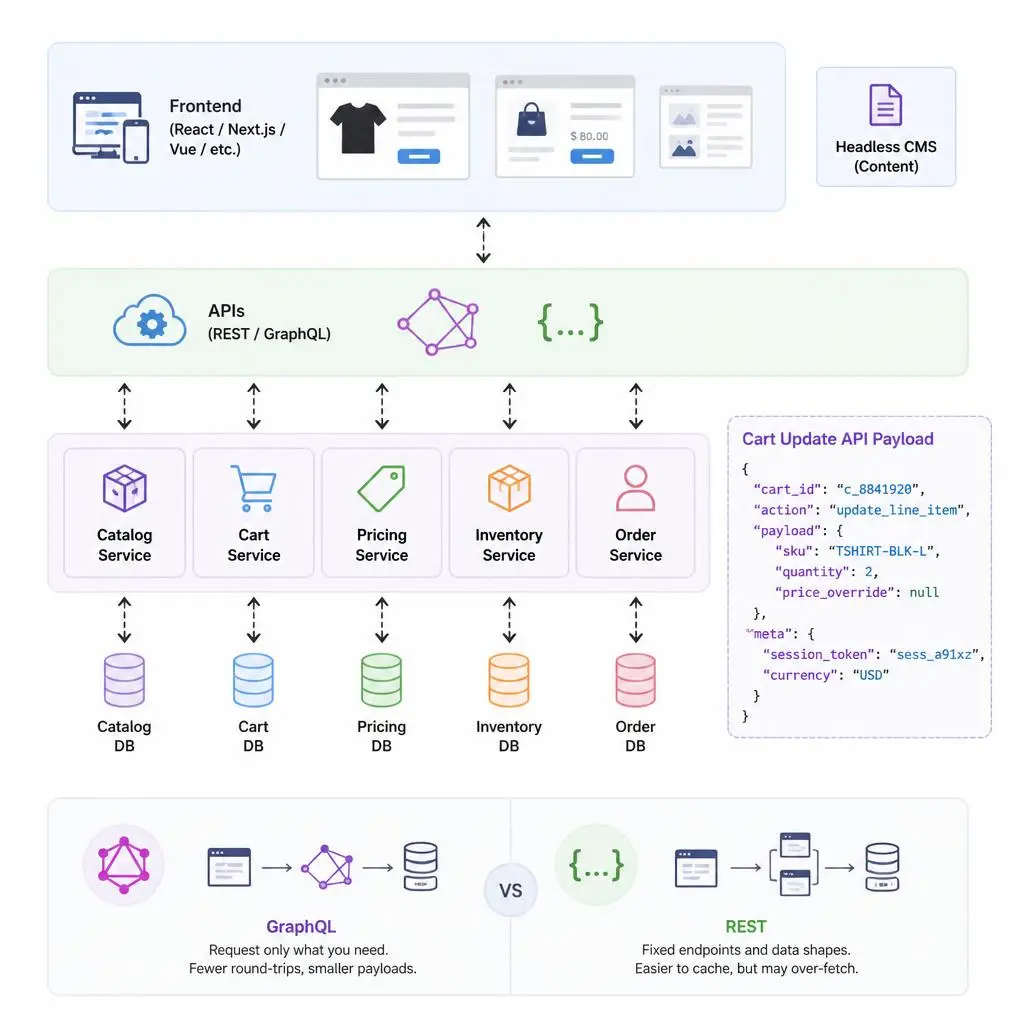
Headless commerce takes the three-tier model further by fully decoupling the frontend from the backend, connecting them exclusively through APIs rather than a shared codebase or templating engine. This is data decoupling in its most complete form – the presentation layer no longer knows or cares how the backend stores or processes data.
In this model, the backend exposes commerce functionality – catalog, cart, pricing, inventory – as discrete, independently deployable services under a broader microservices architecture. Each service typically owns its own data store. The frontend (built in React, Next.js, Vue, or similar) consumes these services purely through REST or GraphQL endpoints, often paired with a headless CMS integration to manage content separately from commerce logic.
A simplified cart-update API payload illustrates the contract between layers:
{
“cart_id”: “c_8841920”,
“action”: “update_line_item”,
“payload”: {
“sku”: “TSHIRT-BLK-L”,
“quantity”: 2,
“price_override”: null
},
“meta”: {
“session_token”: “sess_a91xz”,
“currency”: “USD”
}
}
A critical decision at this layer is GraphQL vs REST APIs. REST exposes fixed endpoints returning predefined data shapes, which is simple to cache but often forces over-fetching (pulling unused fields) or under-fetching (requiring multiple round-trips). GraphQL allows the frontend to request exactly the fields it needs in a single query – reducing payload size and round-trips, at the cost of more complex server-side query resolution and caching logic. Enterprise headless builds increasingly favor GraphQL for catalog and search queries while keeping REST for simpler, cacheable endpoints like static content delivery.
This decoupling delivers three concrete engineering advantages:
- Independent deployment – frontend teams can ship UI updates without redeploying backend services.
- Technology flexibility – each microservice can use the database or language best suited to its workload (e.g., a NoSQL document store for product catalogs, a relational schema for transactional order data).
- Resilience through isolation – a failure in the recommendations service doesn’t cascade into checkout failure, since each service runs independently behind its own load balancers.
Real-world scenario: Commercetools is a leading example of pure microservices architecture applied to commerce. A global fashion retailer expanding into a dozen markets with localized storefronts, multiple currencies, and frequent frontend redesigns would choose Commercetools specifically because each market’s frontend team can iterate independently on the presentation layer while sharing the same underlying commerce API. The trade-off is operational complexity: more services means more network calls, more points of latency, and a genuine need for API gateway management and observability tooling.
The 5-Layer Advanced Ecommerce Website Architecture Framework

Beyond the basic three-tier model, enterprise-grade ecommerce website architecture is best understood as a five-layer system. This framework maps how modern platforms actually distribute responsibility across presentation, logic, core commerce, extended applications, and external integrations – and each layer carries its own scaling considerations, data ownership rules, and failure domains.
Layer 1: The Presentation Layer (UI/UX & Core Web Vitals)
This is everything the customer sees and interacts with – themes, templates, and the rendering engine. In headless setups, this layer is a separate application entirely (often a JAMstack or SSR/SSG frontend) communicating with the backend via APIs, frequently paired with a headless CMS integration such as Contentful or Sanity to manage landing pages, blog content, and merchandising copy independently from the commerce engine itself.
Performance here directly drives Core Web Vitals: Largest Contentful Paint (LCP), Interaction to Next Paint (INP), and Cumulative Layout Shift (CLS) are all measured at this layer, making it the most SEO-sensitive part of the stack. But performance is only half the equation – how the layer is structured also shapes usability. Following established ecommerce ux best practices at this stage, such as predictable navigation patterns and consistent component hierarchies, prevents the kind of layout instability that hurts both conversions and CLS scores simultaneously.
Architecturally, teams must decide between client-side rendering (CSR), server-side rendering (SSR), and static generation (SSG) – each carrying different implications for time-to-first-byte and crawl-friendliness. SSR and SSG generally outperform pure CSR for SEO because content is present in the initial HTML response rather than requiring a JavaScript execution cycle before crawlers can parse it.
Layer 2: The Business Logic Layer (Order Management & Cart Rules)
This layer enforces the rules of commerce: pricing logic, discount stacking, tax calculation, shipping rules, and order state transitions (pending → confirmed → fulfilled → shipped).
It’s also where cart abandonment recovery logic and promotional rule engines typically run, often as event-driven services that respond to cart-update webhooks rather than synchronous polling. At enterprise scale, this layer is frequently split further into sub-services – a pricing engine, a promotions engine, and an order orchestration service – each communicating through internal API payloads rather than direct database access, which prevents one team’s schema changes from breaking another team’s service.
Layer 3: Core Commerce Modules (Catalog Management & User Auth)
This is the operational core: product catalog management, inventory tracking, user authentication, and customer account data.
Catalog data is frequently modeled with a hybrid schema approach – structured attributes (price, SKU, stock) in a relational table for transactional integrity, paired with flexible, schema-less attributes (variant options, marketing copy, custom fields) in a NoSQL or JSON column to accommodate catalog variability without constant migrations.
As catalog size and transaction volume grow into the millions of SKUs or orders, a single database instance becomes a hard ceiling. This is where database sharding becomes necessary – partitioning data horizontally across multiple database instances (commonly by customer region, tenant ID, or product category) so no single node carries the full read/write load. Sharding introduces complexity around cross-shard queries and transactional consistency, which is why most platforms shard only the highest-volume tables (orders, sessions, inventory counters) while keeping smaller reference tables centralized.
User authentication at this layer also benefits from decoupling – increasingly handled by a dedicated identity service (OAuth2/OIDC-based) rather than being embedded directly in the commerce database, allowing single sign-on across storefronts, mobile apps, and B2B portals.
Layer 4: Best-in-Breed Applications & ERP Integrations
Enterprise commerce rarely runs on the core platform alone. This layer covers integrations with ERP systems (SAP, NetSuite, Microsoft Dynamics), PIM (Product Information Management) tools, CRM platforms, and warehouse management systems.
These integrations typically operate via scheduled batch sync, message queues (Kafka, RabbitMQ), or webhook-driven event streams – keeping the core commerce platform from becoming a bottleneck for back-office operations. A common implementation pattern is the event-driven sync model: when inventory changes in the ERP, an event is published to a queue, and the commerce platform’s inventory service consumes it asynchronously rather than polling the ERP on a fixed schedule. This reduces load on legacy ERP systems that were never designed for high-frequency API traffic, and it keeps the storefront’s perceived stock levels reasonably fresh without introducing synchronous dependency chains that could stall checkout if the ERP is slow or offline.
Layer 5: Third-Party Middleware & Payment Gateways
The outermost layer handles connections to payment gateways (Stripe, Adyen, PayPal), tax calculation services (Avalara, TaxJar), fraud detection tools, and shipping carriers.
Because this layer touches sensitive financial data and external uptime dependencies, it’s typically isolated behind a dedicated middleware service that handles retries, cache invalidation for rate/tax lookups, and PCI-DSS compliance boundaries. Tokenizing card data at the payment gateway level – rather than letting raw card details touch your own servers – is the standard approach to minimizing PCI-DSS scope, since it confines sensitive data handling to providers who are already certified for it. This isolation also prevents a third-party outage from taking down your entire checkout flow; a circuit-breaker pattern (failing fast and falling back to a secondary gateway) is standard practice at this layer for high-availability storefronts.
Cloud Deployment Models: SaaS vs. PaaS vs. On-Premises

Once the architectural layers are defined, the next decision is where and how this stack is hosted. Each deployment model carries distinct trade-offs across cost, flexibility, and operational burden – and the right choice depends heavily on catalog complexity, traffic predictability, and internal engineering capacity.
Factor | SaaS (Software-as-a-Service) | PaaS (Platform-as-a-Service) | On-Premises |
Cost Structure | Subscription-based, predictable monthly cost | Usage-based or licensing + infrastructure cost | High upfront capital expenditure |
Customizability | Limited to vendor’s configuration options | High – full code-level access within platform constraints | Unlimited – full control over stack |
Scalability | Vendor-managed auto-scaling | Developer-managed, flexible scaling | Manual capacity planning required |
Maintenance Overhead | Minimal – vendor handles patches, security, uptime | Moderate – team manages app layer, vendor manages infra | High – full responsibility for servers, security, backups |
Best Fit | SMBs to mid-market, fast time-to-market | Mid-market to enterprise needing custom logic | Large enterprises with strict compliance/data residency needs |
SaaS platforms trade customization for speed – ideal when the business model fits standard ecommerce patterns and the team wants to avoid managing infrastructure entirely. Real-world scenario: A fast-growing DTC apparel brand scaling from $5M to $50M in annual revenue is a strong fit for Shopify Plus. The vendor handles load balancers, server provisioning, and PCI compliance for the checkout flow, letting the brand’s small engineering team focus entirely on storefront merchandising, app integrations, and conversion optimization rather than infrastructure maintenance. For founders still evaluating their options, comparing platforms against a guide to the best ecommerce platform for startups is a useful first step before committing engineering resources to any single ecosystem. The limitation surfaces at extreme scale or highly custom checkout flows, where SaaS configuration ceilings start to constrain the business.
PaaS strikes a middle ground, giving developers infrastructure to build custom logic – custom checkout flows, proprietary pricing engines, bespoke B2B quoting tools – without managing physical servers or the underlying OS layer. Commerce-focused PaaS offerings typically expose APIs for catalog, cart, and order management while the platform vendor manages container orchestration, database sharding at scale, and uptime SLAs. This model suits enterprises that have outgrown SaaS configuration limits but don’t want the operational burden of running their own data centers.
On-premises deployments remain relevant for enterprises with strict data sovereignty, regulatory, or legacy-system integration requirements – common in banking-adjacent commerce, government procurement portals, or markets with data residency laws. These deployments demand a dedicated DevOps function to manage uptime, security patching, load balancers, and disaster recovery, since none of that responsibility is abstracted away by a vendor. The trade-off is full architectural control: every layer, from the database engine to the caching strategy, can be tuned precisely to the business’s needs, at the cost of significantly higher operational headcount and capital investment.
Technical SEO Optimization Strategies for Modern Architecture
A well-engineered backend means nothing if search engines can’t efficiently crawl, parse, and rank the resulting pages. These strategies connect architectural decisions directly to organic visibility.
Dynamic Silo Architecture and URL Mapping
A silo architecture organizes URLs into topically grouped hierarchies (e.g., /category/subcategory/product), reinforcing topical relevance signals to search engines.
In headless setups, this requires deliberate URL mapping at the API-routing layer – since the frontend and backend are decoupled, developers must explicitly ensure that dynamically generated routes mirror the intended silo structure rather than defaulting to flat, ID-based URLs (/p?id=8841). This mapping logic typically lives in a routing service that translates backend product/category IDs into SEO-friendly slugs before the API payloads ever reach the frontend renderer.
Handling Crawl Budget via Faceted Navigation and Canonicalization
Faceted navigation (filtering by size, color, price) is essential for UX but dangerous for crawl budget – each filter combination can generate a near-infinite number of crawlable URL permutations.
Mitigation requires a layered approach:
- Canonical tags pointing filtered variations back to the primary category URL.
- Robots.txt disallow rules or noindex directives on low-value parameter combinations.
- Parameter handling configured at the URL-routing layer to avoid duplicate content from sort/filter query strings.
Without this, search engines waste crawl budget on thousands of near-duplicate filtered pages instead of indexing genuinely unique product and category content.
Optimizing Core Web Vitals (INP, LCP, CLS) at the Server Level

Core Web Vitals optimization isn’t purely a frontend task – server-side architecture decisions heavily influence all three metrics:
- LCP (Largest Contentful Paint) improves when the presentation layer fetches above-the-fold data via server-side rendering (SSR) or static generation rather than waiting on client-side API calls after initial load. Since the largest contentful element is frequently a product image, pairing this with a disciplined image seo alt text file names guide – covering WebP compression, descriptive hyphenated filenames, and lazy-loading thresholds – has a direct, measurable effect on LCP scores.
- INP (Interaction to Next Paint) is impacted by main-thread blocking – minimizing synchronous, render-blocking JavaScript bundles at the build/server level reduces input latency.
- CLS (Cumulative Layout Shift) is reduced by reserving layout space for dynamically loaded elements (ads, recommendation widgets) before their async data resolves, preventing late-arriving content from shifting the page.
Server-side cache invalidation strategy also matters here: stale cached fragments served too aggressively can cause inconsistent rendering, while overly conservative cache policies increase server load and degrade LCP under traffic spikes. Edge caching combined with load balancers that distribute traffic across geographically distributed nodes further reduces latency for international audiences – and for teams that need a deeper, hands-on breakdown of this exact problem, a focused ecommerce website speed optimization audit is usually the fastest path to measurable gains.
Common Architectural Pitfalls to Avoid
Even well-funded ecommerce builds fail when these structural mistakes go unaddressed:
- Database blocking – running analytics queries, reporting jobs, or inventory syncs against the same live transactional database that powers checkout, causing lock contention during peak traffic.
- Tightly coupled dependencies – embedding business logic directly inside frontend templates, making it impossible to update one without redeploying the other, and undermining the data decoupling principle that makes modern architectures resilient.
- Poor API performance – chatty APIs that require multiple round-trips to render a single page, instead of consolidated, purpose-built endpoints (or GraphQL queries) that return exactly the data a view needs.
- No caching strategy at the edge – serving every request from origin servers instead of leveraging CDN-level caching for static and semi-static assets.
- Ignoring read/write separation – failing to use read replicas or database sharding for catalog browsing traffic, forcing all read operations to compete with write-heavy checkout transactions on the primary database node.
- Skipping PCI-DSS scope reduction – handling raw payment data within application servers instead of tokenizing at the gateway level, which expands PCI-DSS compliance obligations far beyond what’s necessary.
Each of these pitfalls compounds under scale – a flaw invisible at 100 daily visitors becomes a full outage at 100,000.
Conclusion
Modern ecommerce website architecture is no longer a binary choice between monolith and microservices – it’s a layered decision spanning presentation, business logic, core commerce modules, third-party integrations, and deployment model.
The platforms that scale gracefully into 2026 and beyond share common traits: decoupled services, deliberate caching strategy, SEO-aware URL structures, and clean separation between read-heavy and write-heavy workloads. Whether the right fit is a monolithic platform like Magento for deep customization, a SaaS solution like Shopify Plus for speed, or a microservices-based platform like Commercetools for multi-market flexibility, the decision should map directly to catalog complexity, traffic patterns, and internal engineering capacity.
Whether you choose SaaS for speed, PaaS for flexibility, or on-premises for control, the underlying architectural discipline – clean layering, observable API payloads, load balancers tuned for real traffic patterns, and crawl-friendly site structure – is what separates a platform built to last from one destined for a costly rebuild. Architecture decisions also don’t end at launch: ongoing WebsiteMaintenance Services are what keep these systems performant, secure, and SEO-stable as traffic, catalog size, and third-party dependencies grow over time.
If you’re mapping out a new build or auditing an existing platform against this framework, you can explore more technical breakdowns on the RyDesk homepage, or contact us directly to discuss your specific architecture and scale requirements.
FAQs
How does ecommerce website architecture impact Core Web Vitals?
Architecture directly shapes Core Web Vitals because rendering strategy, API response time, and caching policy are all architectural decisions. Server-side rendering improves LCP, minimized render-blocking logic improves INP, and reserved layout space for async content improves CLS – all of which trace back to how the presentation and business logic layers are structured.
What is the difference between headless and monolithic commerce architecture?
A monolithic architecture bundles the frontend, business logic, and data layer into a single, tightly coupled codebase, meaning UI changes and backend changes ship together – Magento is a common example. Headless architecture fully separates the frontend from the backend, connecting them only through API payloads via REST or GraphQL – allowing each side to be developed, deployed, and scaled independently, as seen in platforms like Commercetools.
How do you design an enterprise-level scalable database for ecommerce?
Enterprise-scale database design typically combines a relational (SQL) schema for transactional data requiring strict consistency (orders, payments, inventory counts) with a NoSQL or document-based store for flexible, high-variability data like product catalogs and customer behavior logs. Read replicas separate catalog-browsing traffic from checkout writes, while database sharding distributes load horizontally as order volume and SKU count grow into the millions.
What are the key components of a 3-tier ecommerce architecture?
A three-tier architecture consists of the Presentation Layer (UI/UX rendering), the Business Logic Layer (cart rules, pricing, order workflows), and the Data Layer (relational database storing products, customers, and orders). Each tier scales and deploys independently, which is what makes this model the enterprise standard over fused two-tier systems.
Is headless commerce architecture suitable for small businesses?
Headless architecture offers the most flexibility but introduces higher development and maintenance costs, making it better suited to mid-market and enterprise brands with dedicated engineering teams. Small businesses with limited technical resources generally see faster ROI from a SaaS platform like Shopify Plus, where infrastructure and PCI-DSS compliance are vendor-managed.
How does database sharding improve ecommerce performance?
Database sharding partitions data horizontally across multiple database instances – commonly by region, tenant, or product category – so no single node carries the full read/write load. This prevents lock contention during high-traffic events like flash sales, where order writes and catalog reads would otherwise compete on the same database instance.