Quick Answer
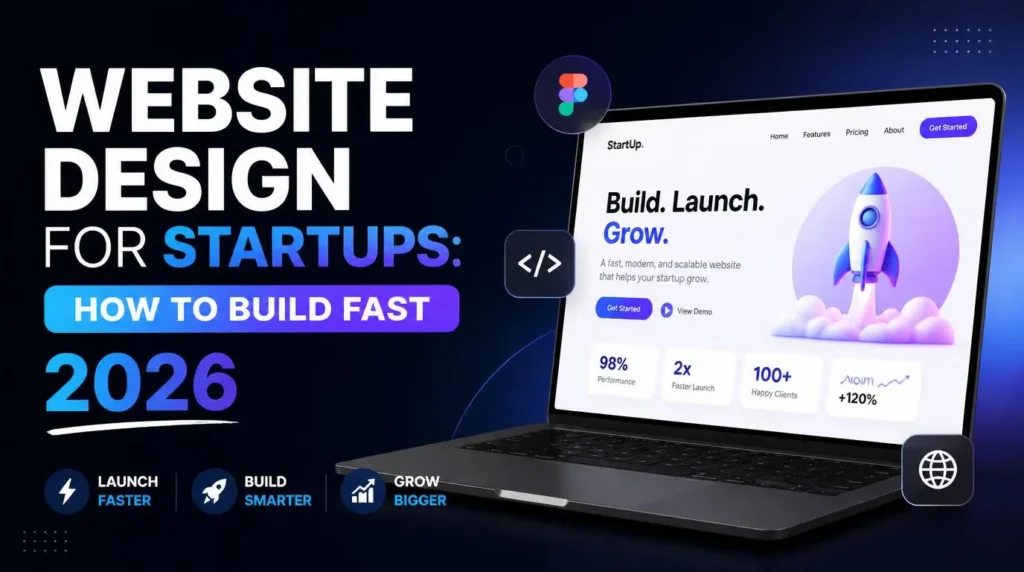
Startup website design should prioritize speed, a clear value message, and a simple user path from the very first screen – not visual complexity. Startups don’t need every feature; they need a site that explains what they do in seconds, loads fast on mobile, and gives visitors one clear next step.
Proof: How This Ranks in AI Overviews
This isn’t a theory. Google’s AI Overview for “web design for startups” pulls its answer directly from a competitor page’s opening line – not from deep body content, headers, or bullet lists further down. The takeaway: AI systems extract the first clear, self-contained answer statement on a page and quote it directly. That’s why this article leads with a direct-answer statement immediately after the H1, before any other content.
Quick Summary
Element | What It Should Do |
Hero section | Deliver the value pitch in one sentence, above the fold |
Load speed | Under 2–3 seconds – affects both users and AI/search indexing |
Layout priority | Mobile-first, not desktop-first |
Primary CTA | One clear action, repeated consistently across the page |
Trust signals | Logos, testimonials, or results, even in early stages |
Structure | Scalable – can add pages/content without a full redesign |
What a Startup Website Actually Needs
- A clear value pitch above the fold – visitors decide in seconds whether to stay
- Fast load speed – slow sites lose both users and search/AI visibility (see this website speed optimization checklist)
- One primary call-to-action per page – “Get Started,” “Book a Call,” or similar, repeated consistently
- Mobile-first layout – most early traffic comes from mobile and social links
- Trust signals – client logos, testimonials, or results, even in early stages
- Room to scale – a structure that can add pages and content without a redesign
Key Sections Every Startup Website Should Have

- Hero Area – bold headline, one-line subheadline, and a direct action button (see creative hero section design ideas)
- Product/Service Demo – a clean visual, short video, or screenshot showing what the startup actually does
- Social Proof – logos, early customer quotes, or press mentions, even if limited
- Feature Breakdown – short, scannable list of core benefits (not a long feature dump)
- Contact/CTA Section – a low-friction way to reach out or sign up
Common Mistakes in Startup Web Design
Mistake | Why It Hurts |
Generic stock photos | Reduces trust and looks templated |
Too much text on the homepage | Visitors leave before finding the value pitch |
No clear CTA | Traffic arrives but doesn’t convert |
Desktop-first design | Breaks on the majority of first-time visits – see responsive web design for SEO |
Slow load speed | Hurts both user retention and search/AI indexing |
Design Best Practices for Startups

- Keep text simple – explain the value in one sentence, not a paragraph
- Use strong CTAs – make the primary action button visible on every screen
- Optimize for mobile first – design the phone layout before the desktop one more in web design with SEO strategy
- Use real product screenshots – not generic stock imagery
How RyDesk Builds Startup Websites
RyDesk designs startup websites with speed, mobile-first layout, and SEO structure built in from the first wireframe – so the site is ready to convert visitors and rank in search from day one, without a second redesign project later. See RyDesk’s premium web design packages for full scope and pricing.
Conclusion
A startup website’s job isn’t to look impressive – it’s to explain the value fast, load faster, and give visitors one clear next step. RyDesk builds that structure in from the start. Homepage or RyDesk’s Web Design Services or Contact us .
FAQs
What’s the most important element on a startup website?
A clear, one-sentence value pitch above the fold – visitors decide whether to stay within seconds of landing.
Should a startup website launch with every feature planned?
No – launching with a focused core structure and adding features later performs better than delaying launch for a fully-loaded site.
How fast should a startup website load?
Under 2-3 seconds is the general benchmark; slower load times measurably increase visitor drop-off.
Does a startup need a mobile-optimized website first?
Yes – most early-stage traffic (social links, ads, referrals) arrives on mobile devices first.