

Quick Summary
Cache Type | Where It Lives | Clear Time | Fixes |
Browser | Your computer | 10 seconds | You see old version, others don’t |
Plugin | WordPress dashboard | 30 seconds | Nobody sees the update |
Hosting | Server level | 1-2 minutes | Update works in incognito, not normal browsing |
CDN | Cloudflare/edge network | 1-5 minutes | Works locally, not for visitors elsewhere |
You updated your site. You hit refresh. Nothing changed.
That’s not a bug. That’s cache doing its job – just at the wrong time.
Cache exists to make your site fast. It stores a snapshot of your pages so browsers, servers, and CDNs don’t rebuild them from scratch every visit. Great for speed. Bad when you just edited something and the internet is still showing you yesterday’s version.
Here’s the thing most guides skip: there isn’t one cache. There are four – browser, plugin, hosting, and CDN – stacked on top of each other. Clear one and the other three still hold the old version. That’s why “I cleared my cache” often doesn’t fix anything. This guide clears all four, in the right order, and tells you what to do when clearing cache still doesn’t work.
Method 1: Clear Browser Cache

If only you see the old version – not other visitors – this is your fix. Your browser is holding onto old files.
Chrome:
- Press Ctrl + Shift + Delete (Windows) or Cmd + Shift + Delete (Mac)
- Set time range to “All time”
- Check “Cached images and files”
- Click “Clear data”
[Placeholder: Insert screenshot here – Chrome cache clearing dialog with “Cached images and files” checkbox highlighted]
Firefox:
- Press Ctrl + Shift + Delete
- Select “Everything” from the time range
- Check “Cache”
- Click “Clear Now”
[Placeholder: Insert screenshot here – Firefox clear data window]
Safari:
- Go to Safari menu → Settings → Advanced
- Enable “Show Develop menu”
- Click Develop → Empty Caches
[Placeholder: Insert screenshot here – Safari Develop menu with Empty Caches option]
Faster option: Hard refresh instead of clearing everything.
- Windows: Ctrl + F5
- Mac: Cmd + Shift + R
Browser cache is the easiest fix, but it’s also the smallest piece of the puzzle. If your site is still sluggish after this, the deeper issue is usually structural – worth running through our full website speed optimization checklist to see what else might be dragging load times down.
Method 2: Clear Plugin-Level Cache

If browser clearing didn’t fix it, check your caching plugin next. This is the most common culprit for “I updated it but nobody sees it.”
WP Rocket:
- Go to Settings → WP Rocket
- Click “Clear Cache” in the top bar
[Placeholder: Insert screenshot here – WP Rocket dashboard with Clear Cache button circled]
LiteSpeed Cache:
- Go to LiteSpeed Cache → Toolbox
- Click “Purge All”
[Placeholder: Insert screenshot here – LiteSpeed Cache Toolbox purge options]
W3 Total Cache:
- Go to Performance → Dashboard
- Click “Empty All Caches”
[Placeholder: Insert screenshot here – W3TC dashboard Empty All Caches button]
No plugin installed? Check anyway – some hosts bundle one by default (SiteGround Optimizer, WP Engine’s built-in cache, etc.). Log into your dashboard and look for a “Cache” or “Speed” menu.
Caching plugins are powerful, but they’re only one layer of a healthy WordPress setup. If you’re not on a regular update-and-maintenance schedule, cache conflicts like this will keep resurfacing – here’s what a proper WordPress maintenance routine should actually include.
Method 3: Clear Hosting-Level Cache
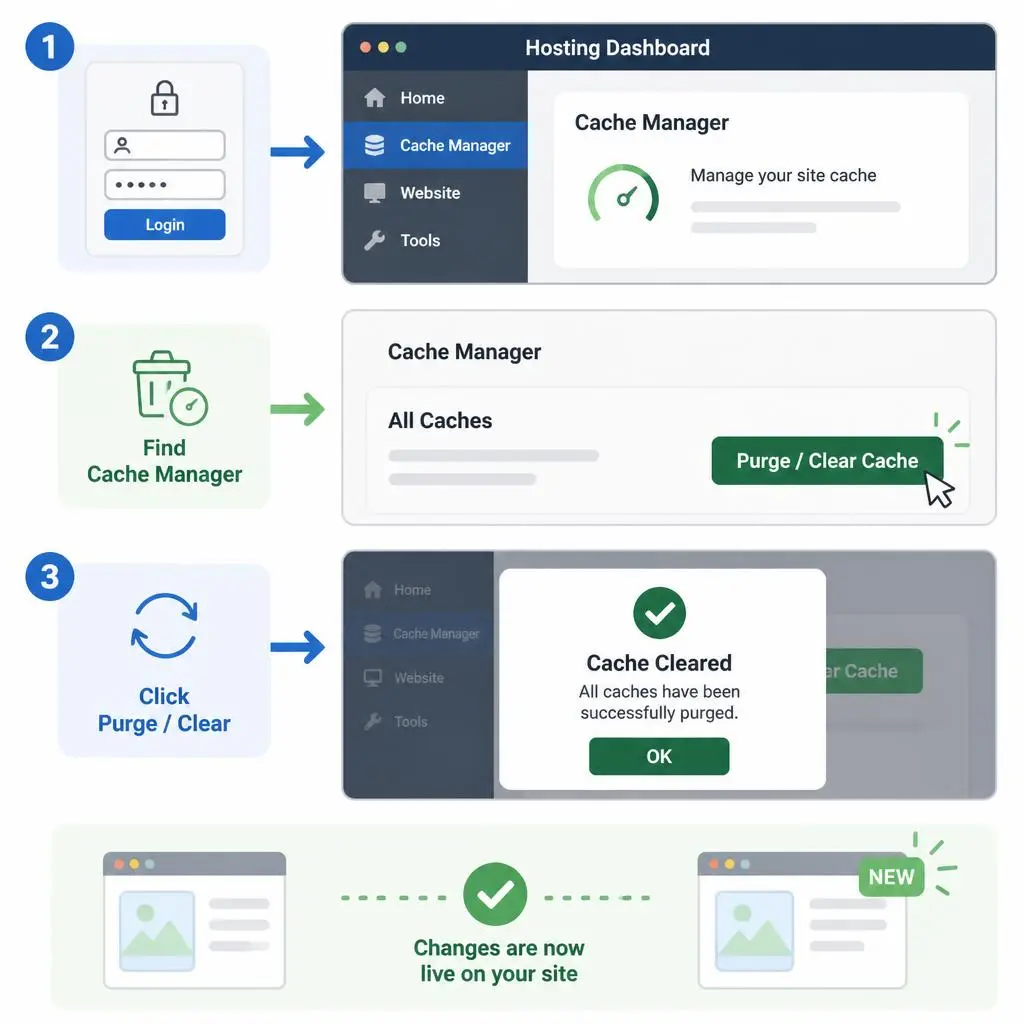
Your plugin cache is clear, but the change still isn’t live? Your host is caching independently of WordPress. This happens a lot with managed WordPress hosts.
- Log into your hosting dashboard (cPanel, WP Engine, Kinsta, SiteGround, etc.)
- Look for “Cache Manager” or “Purge Cache”
- Click purge/clear
[Placeholder: Insert screenshot here – cPanel or hosting dashboard cache purge button, labeled by host name]
Common host-specific paths:
- SiteGround: Site Tools → Speed → Caching → Dynamic Cache → Flush Cache
- WP Engine: User Portal → your site → Cache tab → Clear all caches
- Kinsta: MyKinsta → your site → Tools → Clear Cache
If you don’t know your host’s exact path, search “[your host name] purge cache” – every host names this differently.
Hosting-level cache is invisible to most site owners until something breaks. Pair this with a consistent update schedule – our guide on how often you should update your website covers exactly where caching gaps like this tend to slip through.
Method 4: CDN and Object Cache

Still stuck? Two more layers, usually overlooked.
Cloudflare:
- Log into Cloudflare dashboard
- Select your domain
- Go to Caching → Configuration
- Click “Purge Everything”
[Placeholder: Insert screenshot here – Cloudflare Caching tab with Purge Everything button]
Object Cache (Redis/Memcached):
This one’s invisible to most users but breaks a lot of “why won’t this update” tickets. If your host uses Redis or Memcached for object caching:
- Most caching plugins have an “Object Cache” purge option separate from page cache
- Or ask your host to flush it manually – this usually isn’t user-accessible
If you’re running WooCommerce and prices/stock aren’t updating, object cache is almost always the reason. Page cache purge alone won’t fix it.
If you’re running WooCommerce and object cache is the culprit, this usually isn’t a one-time fix – it’s a sign your store needs dedicated performance handling. Our breakdown of ecommerce website speed optimization covers the caching layers that matter most for stores specifically.
Troubleshooting: Why Cache Won’t Clear (Or Clearing Doesn’t Help)

This is where most guides stop. It’s where your actual problem usually is.
You cleared everything and it’s still broken.
- Check if you’re editing a cached page in a different environment (staging vs. live). You might be clearing cache on the wrong site.
- Multiple CDNs stacked (Cloudflare + host-level CDN) means one purge doesn’t cover both. Purge each separately.
Clearing cache fixed the display but broke the layout.
- This is a CSS caching conflict, not a content issue. Your page builder (Elementor, Divi) generates its own CSS cache separate from your caching plugin.
- Go to your page builder settings and regenerate CSS files, then clear plugin cache again.
Cache keeps coming back immediately after clearing.
- A cron job or scheduled cache-warming feature is rebuilding it right after purge. Check your caching plugin’s preload/warmup settings and disable temporarily to test.
Different visitors see different versions.
- CDN edge nodes cache separately by geographic location. A full purge takes time to propagate globally – give Cloudflare 5-10 minutes before assuming it failed.
You’re an admin, so you see fresh content, but customers don’t.
- Most caching plugins exclude logged-in admins from cache by default. This is normal, not a bug. Test in an incognito window to see what real visitors see.
Server-level caching conflicts with plugin caching.
- If your host runs its own caching layer (common with LiteSpeed servers) and you’re also running W3TC or WP Rocket, they can conflict and serve inconsistent versions. Run one, not both – pick your host’s native option if it has one.
Nothing above works and the site is still slow, not just showing old content.
- At this point, cache isn’t your problem. It’s likely bloated plugins, unoptimized images, or poor hosting resources. Clearing cache won’t fix a fundamentally slow site – it just hides the problem temporarily.
When DIY Cache Fixes Aren’t Enough
If you’ve cleared all four cache layers and your site is still slow – not “old content” slow, but genuinely sluggish – cache was never your real problem. That’s a sign of deeper performance issues: bloated plugins, poor hosting, unoptimized images, or render-blocking code stacking up underneath the cache. This is exactly what our Website Speed Optimization Services are built to fix – a full audit and cleanup, not another cache-clearing loop.
conclusion
Cache issues feel confusing because there are four separate layers pretending to be one problem. Once you know that, troubleshooting stops being guesswork. Clear each layer in order – browser, plugin, hosting, CDN – and 90% of “changes not showing” issues resolve on the spot. If your site is still slow after that, cache was masking a real performance problem, not causing one. Ready to fix it properly instead of clearing cache every week? Explore our WebsiteMaintenance Services , head back to our Homepage to see the rest of what we do, or Contact Us directly for a speed audit.
FAQs
- Why do I still see old content after clearing my browser cache?
Because browser cache is only one of four cache layers. Your plugin, host, or CDN is likely still serving the old version. - How often should I clear WordPress cache?
Only after making changes – content updates, plugin installs, theme edits, or CSS changes. Clearing it constantly defeats its purpose, which is speed. - Does clearing cache delete my content?
No. Cache is a temporary copy for faster loading. Clearing it just forces WordPress to rebuild that copy – your actual content, stored in the database, is untouched. - Why does my site load fine in incognito but not in my regular browser?
Your regular browser has cached files. Incognito mode starts fresh with no cache, which is why it shows the current version. - Can I clear cache without a plugin?
Yes, but it’s harder. Without a plugin, you’d need to clear cache manually at the server level (via .htaccess or hosting dashboard) since there’s no dashboard button to click. - Why does WooCommerce show wrong prices or stock after clearing cache?
This usually means object cache (Redis/Memcached), not page cache. Object cache needs to be purged separately – check your host or caching plugin for that option. - Should I use both a caching plugin and my host’s built-in cache?
No. Running two caching systems at once often causes conflicts and inconsistent results. Pick one – usually your host’s native caching if it offers one – and disable the other. - Why did my site break after I cleared cache?
This is almost always a CSS regeneration issue with your page builder, not the cache clear itself. Regenerate CSS in Elementor or Divi settings, then clear cache again.