

Quick Answer
Question | Answer |
What is this? | A step-by-step 2026 blueprint for building a scalable, high-performing WordPress site for small business growth |
Why WordPress? | Powers over 43% of the internet, fully owned (no platform lock-in), and infinitely scalable as the business grows |
Speed target | Under 2.5 seconds load time on mobile |
Core plugin stack | SEO plugin, caching solution, lead-capture form, security plugin, backup solution — nothing more |
DIY vs Professional | DIY: 3–6 weeks, higher long-term cost. Professional: 2–4 weeks, built right the first time |
Best result | A fast, ranking, owned website that converts visitors into leads — not just a pretty brochure site |
WordPress is the premier choice for scalable small business web design because it powers over 43% of the internet, remains highly cost-effective, and gives full ownership of data without platform lock-in. Built on open-source software, it delivers maximum customization, strong SEO capability, and infinite scalability as a business grows.
Why WordPress Dominates Small Business Websites

- Total Data Ownership: Unlike closed website builders, the business can migrate files and hosting at any stage of growth – nothing is locked behind a platform’s login screen.
- Built-In SEO Advantage: Clean code, fully editable permalinks, and simple image alt-text metadata maximize search discoverability from day one. . This foundation is critical to our responsive web design for SEO approach, ensuring that your site isn’t just crawlable, but optimized for every device your customer uses.
- Scalable Infrastructure: A brochure site today can become a booking system, an ecommerce store, or a full membership hub later – without a platform migration.
- Extensive Plugin Ecosystem: Thousands of specialized tools add functionality on demand – quote calculators, live chat, booking systems – without touching the core codebase.
This isn’t theoretical. It’s exactly why WordPress remains the default recommendation across the web design industry heading into 2026 – and why the businesses that treat it as a rented template, instead of an owned asset, are the ones losing ground.
Step-by-Step Blueprint to Build a Scalable WordPress Site

1. Secure Domain and Hosting
- Select Domain: Pick a short, memorable address that aligns directly with the registered company name.
- Acquire Reliable Hosting: Choose a trusted environment with automated installers and strong uptime – this is the single biggest factor in real-world site speed.
- Enforce SSL Protocol: Enable HTTPS during setup to protect customer data and build search engine trust – sites without SSL are actively penalized in rankings.
2. Choose Your Design Interface
- Utilize Theme Frameworks: Install a lightweight, responsive foundation to manage headers and sitewide styling without unnecessary code weight.
Deploy Page Builders With Discipline:
drag-and-drop editors like Elementor or Divi let a business construct pages visually without touching raw code – but used carelessly, they’re the single biggest cause of a bloated, slow-loading site. Flattening the DOM and limiting animation is what separates a fast builder-based site from a sluggish one, a discipline covered in our how to eliminate render-blocking resources guide.
3. Map Essential Small Business Pages
- Homepage: A prominent logo, an explicit value statement, and an actionable call-to-action above the fold – this page has three seconds to earn attention.
- About Us Page: Company mission, background, team profiles, and credentials – built to establish baseline credibility, not tell a life story.
- Services / Shop Page: Transparent offerings paired with a clear, functional pricing structure – ambiguity here is where visitors quietly leave.
- Contact Page: Simple submission forms, an embedded local map, phone numbers, and a physical business address – every field removed is friction removed.
4. Configure Essential Functional Plugins
- For Search Optimization: Install an SEO plugin like RankMath or Yoast to fine-tune metadata, schema, and keyword targeting.
- For Form Captures: Deploy a lightweight lead-generation form tool to capture client inquiries and appointment requests without adding page bloat.
- For Ecommerce Power: Integrate WooCommerce to process secure digital payments and manage store inventory.
- For Site Security: Guard core business assets against digital attacks with a dedicated security plugin monitoring for threats around the clock.
Crucial Design Optimization Rules
Fast Load Speed → Compress every image before upload and lazy-load anything below the fold.
Mobile-First Design → Build responsive layouts for small screens first, then scale up to desktop.
Clear Local SEO → Explicitly map geo-keywords into titles, tags, and page content.
Two supporting rules make these three actually work in practice:
- Optimize Images: Compress all photos and use descriptive alt text to improve both speed and accessibility simultaneously – not as a keyword-stuffing exercise, but as genuine context for screen readers and search engines alike.
- Prioritize Mobile Views: Ensure buttons are easily clickable on small screens, since Google indexes the mobile layout first – a slow or broken mobile experience directly affects rankings regardless of desktop polish.
DIY vs. Professional Build – What Actually Changes
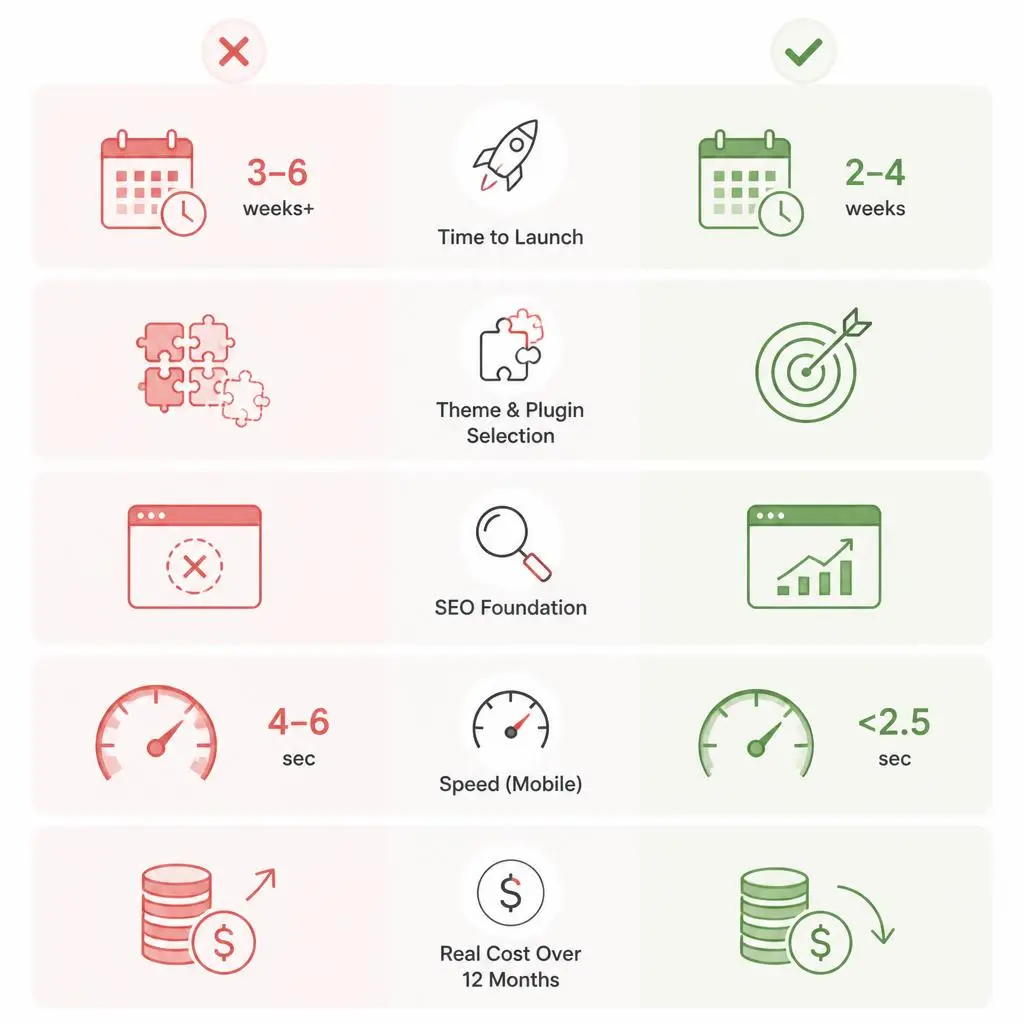
A lot of business owners start the DIY route because it looks like the cheaper option. Sometimes it is. Often, the real cost shows up six months later.
- Time to Launch – DIY: 3–6 weeks, often longer. Professional: 2–4 weeks.
- Theme and Plugin Selection – DIY: trial and error, frequent bloat. Professional: chosen for the specific business goal.
- SEO Foundation – DIY: usually added after launch, if at all. Professional: built into the architecture from day one.
- Speed – DIY: often 4–6 seconds on mobile without intervention. Professional: typically under 2.5 seconds.
- Real Cost Over 12 Months – DIY: lower upfront, higher in lost traffic and rework. Professional: higher upfront, lower total cost of ownership.
Mobile-First Optimization & Local Authority

Google indexes the mobile version of a site first. Not desktop. If the mobile experience is broken, the ranking is broken, regardless of how polished the desktop version looks.
For local businesses, this pairs directly with NAP consistency – Name, Address, Phone matching exactly across the website, Google Business Profile, and every directory listing. A mismatched detail on even one directory quietly erodes how much Google trusts the business’s legitimacy.
Getting the technical foundation right across responsive layouts and local signals together is exactly what our responsive web design for SEO approach is built around – and understanding why mobile website speed lags behind desktop is the first step to fixing it before it costs a single lead.
Image handling deserves its own attention here too. The full breakdown of alt text and file naming done correctly is covered in our image SEO and alt text guide.
Need Expert Implementation?
If you need a professional site built to these standards, our WordPress Website Designers service is designed for businesses that value speed and ROI over generic templates. We strip out the bloat and build a sales engine, not just a website.
Conclusion
A scalable WordPress site isn’t a nice-to-have in 2026 – it’s the difference between a business that compounds its traffic and one that quietly loses ground to competitors who got the architecture right. Ownership, speed, and structure aren’t separate decisions. They’re the same decision, made once, at the start.
Stop treating the website as a line item and start treating it as infrastructure. Every day spent on a slow, locked-in platform is a day handed to a competitor with a faster, owned site.
If you’re ready to build something that actually performs, visit our Rydesk Homepage to see the full range of work, explore our WebsiteMaintenance Services service, or Contact Us directly to talk through what a scalable build looks like for your business.
FAQs
What does “scalable WordPress web design” actually mean?
It means building a site architecture that grows with the business without requiring a full rebuild – clean code, disciplined plugin use, and a page structure designed for lead generation from day one.
Is WordPress better than Wix or Squarespace for small business?
For businesses planning to grow past a basic brochure site, yes. WordPress offers full ownership, unrestricted SEO control, and scalability that closed builders cap by design.
How fast should a small business website load in 2026?
Under 2.5 seconds on mobile is the practical target. Anything slower measurably increases bounce rate and hurts search rankings.
What’s the biggest architectural mistake small businesses make?
Installing plugins without a clear purpose for each one. Every unnecessary plugin adds load time and a future point of failure.
Why does mobile speed matter more than desktop speed?
Google indexes the mobile version of a site first. A slow or broken mobile experience directly affects rankings, regardless of desktop performance.
What’s the minimum plugin stack a WordPress site actually needs?
An SEO plugin, a caching solution, a lead-capture form tool, a security plugin, and a backup solution. Everything beyond that needs to justify its existence in load time.
How does NAP consistency affect local SEO?
Name, Address, and Phone number need to match exactly across the website, Google Business Profile, and directory listings. Inconsistencies erode the trust signal search engines use to verify business legitimacy.
Do I need a developer to keep a WordPress site fast and secure?
Not for daily content updates, but ongoing plugin updates, security monitoring, and performance checks benefit from dedicated attention – most site failures trace back to this being neglected after launch.