

Quick Answer
Destination Keyword Targeting
Focus on long-tail, location-based keywords like “things to do in Bali in July.” These bring high-intent traffic and convert better than broad keywords. Tools: Ahrefs, Semrush.
Destination Page Architecture
Create separate, detailed pages for each destination. This improves site structure and builds strong topical authority in Google.
Seasonal Content Planning
Publish content before peak travel demand starts. This helps you rank early when competition is still low. Tool: Google Trends.
Travel Schema Markup
Use structured data like FAQ, Review, and TouristAttraction schema to improve visibility in rich results and AI search. Tools: Schema.org, RankMath.
Ranking a travel website on Google in 2026 is genuinely hard – you’re competing against Expedia, Booking.com, and TripAdvisor, all of which have domain ratings above 90. But thousands of small travel brands do break through, and they do it by targeting the gaps those giants ignore.
This guide covers the exact SEO strategies that work for travel websites right now – from destination page architecture to seasonal content calendars to schema markup that earns rich results.
Why Travel SEO Is a Different Game Entirely

Most generic SEO advice doesn’t account for what makes travel sites uniquely difficult.
You’re competing against aggregators with unlimited budgets. Booking.com spends roughly $6 billion per year on marketing and has millions of backlinks. You won’t outrank them on “hotels in Paris.” But you can outrank them on “best boutique hotels in Montmartre for couples under $150/night.”
Search intent shifts with the booking journey. A traveler in the dreaming phase searches “places to visit in Southeast Asia.” Six weeks later, the same person searches “Chiang Mai 7-day itinerary with family.” Your content strategy must serve both.
Seasonality creates content windows. Search interest for “Maldives honeymoon packages” peaks in November and December. If your post goes live in January, you’ve missed the window. Google needs 2–3 months to index and rank new content – meaning you need to publish months ahead of demand spikes.
For a strong foundation, make sure your site itself is built with SEO in mind from the start. Read our guide on SEO-friendly website design SEO-friendly website design to understand what that looks like technically.
Step 1: Keyword Research Designed for Travel Intent

Target the Four Layers of Travel Search Intent
Travel searches fall into four categories, and your content strategy needs to cover all of them.
- Dreaming Keywords – Broad inspiration searches
Examples: “best places to travel in Europe,” “most beautiful beaches in the world”
These are high-volume, very competitive. Good for pillar content, not conversion.
- Planning Keywords – Research-stage searches
Examples: “how many days in Tokyo,” “is Bali safe to travel 2026,” “best time to visit Morocco”
These convert well because the traveler is actively planning. Competition is lower than dreaming keywords.
- Booking Keywords – High-intent transactional searches
Examples: “Santorini tour packages from UK,” “cheap flights Lahore to Dubai October”
These are money keywords. Even low volume ones (500 searches/month) can drive direct bookings.
- Post-Trip Keywords – Reviews, packing lists, tips
Examples: “what to pack for Iceland in winter,” “Airbnb vs hotel in Lisbon”
These build topical authority and attract backlinks from travel bloggers.
How to Find Gaps the Big Players Miss
Go to Ahrefs, enter Booking.com, filter by Keyword Difficulty under 30, then add a “words: 5+” filter. You’ll find thousands of long-tail destination terms that massive OTAs haven’t bothered creating dedicated content for.
Real example:
best day trips from Prague by train gets 2,400 searches/month with a KD of 18. Booking.com doesn’t have a page targeting that exact phrase. A focused travel blog or tour operator absolutely can.
Step 2: Build a Destination Page Architecture That Scales
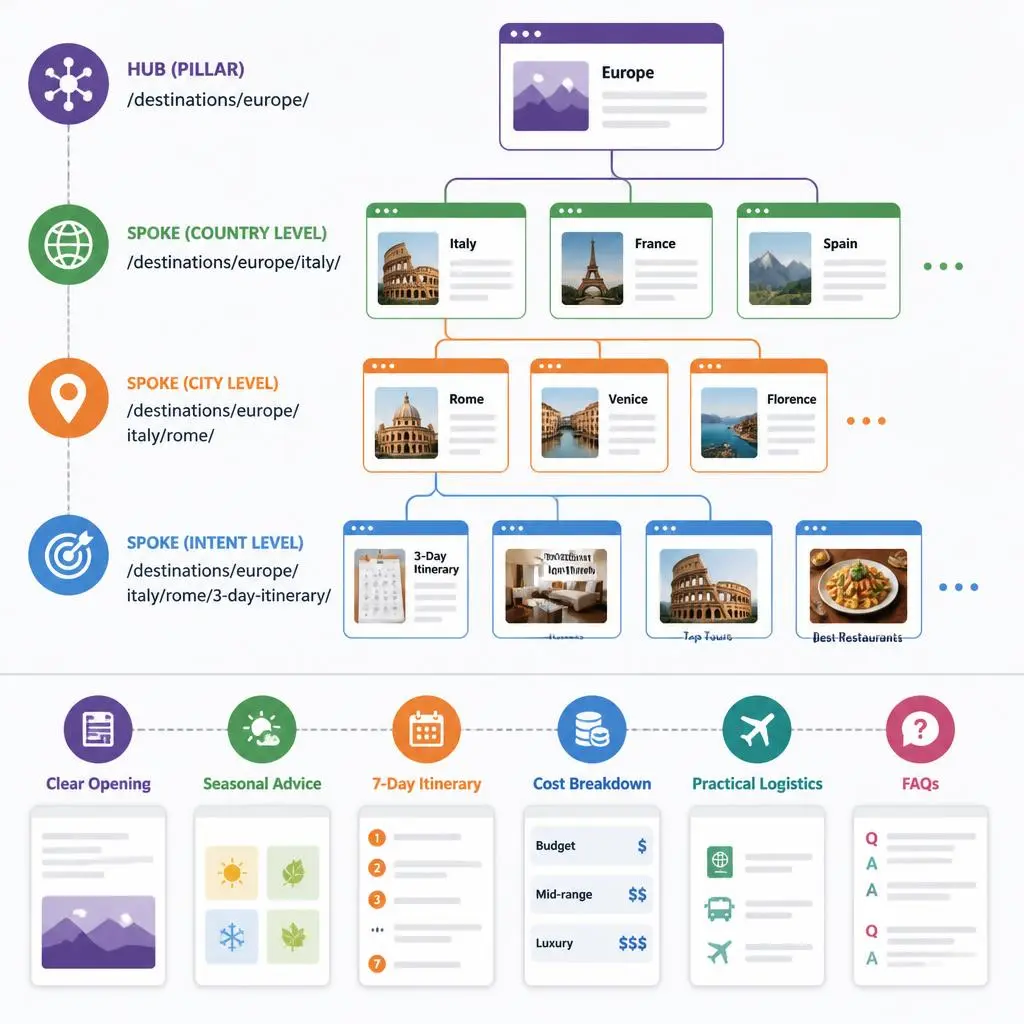
The Hub-and-Spoke Model for Travel Sites
One of the biggest SEO mistakes travel websites make is publishing destination content in a flat structure – every destination at the same level, with no hierarchy. Google can’t determine which pages are most important.
Instead, build a hub-and-spoke model:
Hub Page (Pillar): /destinations/europe/
Covers Europe travel broadly; links to all country pages
Spoke Pages (Country Level): /destinations/europe/italy/
Covers Italy travel; links to all city pages
Spoke Pages (City Level): /destinations/europe/italy/rome/
Covers Rome specifically; links to category pages (hotels, tours, restaurants)
Spoke Pages (Intent Level): /destinations/europe/italy/rome/3-day-itinerary/
Highly specific, high-converting content
This structure passes authority logically down the chain and signals to Google that your site has genuine depth on the topic.
Not sure how many pages your travel site actually needs? Our breakdown of how many pages a website should have how many pages a website should have gives a practical answer.
What Every Destination Page Needs
Generic destination pages don’t rank in 2026. Google’s Helpful Content system actively deprioritizes thin, templated content. Each destination page should include:
A clear opening that names the destination, explains who it’s for, and gives a quick overview – not just “X is a beautiful place”
Seasonal travel advice specific to that destination – not generic “check the weather” advice
A 7-day or multi-day itinerary section – this alone earns significant long-tail traffic
Cost breakdown covering budget, mid-range, and luxury estimates
Practical logistics including visas, transport between spots, and best airlines
FAQs structured with proper schema – covered in Step 5
A real-world example: Tourism Tiger, a tour operator website builder, consistently outranks OTAs on niche destination searches because their client pages include operator-specific knowledge – the exact pick-up point for a Machu Picchu tour, what to bring on a specific safari, altitude warnings for Cusco. That level of specificity is something Booking.com simply cannot replicate at scale.
Step 3: On-Page SEO for Travel Content
Title Tags and Meta Descriptions That Get Clicks
Travel search results are crowded. Your title and meta need to give a reason to click over the OTA sitting above you.
Weak title: Best Things to Do in Bali
Strong title: 17 Best Things to Do in Bali (2026 Local Guide – Not a Tourist Trap)
Weak meta: Discover the best activities in Bali for your holiday.
Strong meta: Skip the overrated spots. This Bali guide covers hidden waterfalls, real warung restaurants, and off-season pricing – from someone who’s been 4 times.
The “from someone who’s been X times” or “local guide” framing directly addresses EEAT concerns and increases CTR.
Header Structure for Travel Content
Use headers to mirror how travelers actually think through a destination – not just generic H2s.
Instead of: H2: Things to Do
Use:
H2: What to Do in Bali – By Interest Type
H3: For First-Time Visitors: The Can’t-Miss Experiences
H3: For Repeat Travelers: Off-the-Beaten-Path Spots
H3: For Families: Kid-Friendly Activities That Don’t Feel Like a Zoo
This structure targets more long-tail variants naturally and keeps users on the page longer – both of which improve rankings.
Image Optimization Specific to Travel
Travel pages are inherently image-heavy. Unoptimized images are one of the biggest reasons travel sites fail Core Web Vitals, which directly impacts rankings. For design inspiration on how travel hero sections should look visually, see our creative hero section design ideas creative hero section design ideas .
Convert all images to WebP format – typically 25–35% smaller than JPEG
Use descriptive, keyword-rich filenames: santorini-blue-dome-churches-oia-sunset.webp – not IMG_4821.jpg
Write alt text that describes the scene specifically: “Blue-domed churches of Oia, Santorini at golden hour” – not “Santorini photo”
Use lazy loading for all images below the fold
Compress using ShortPixel or Imagify if you’re on WordPress
Step 4: Technical SEO for Travel Websites
Handle Seasonal URL Structures Carefully
A common mistake is creating year-specific URLs like /best-beaches-2025/ then redirecting or updating them every year. This burns link equity. Instead, use evergreen URLs like /best-beaches-bali/ and update the content annually. Add “Updated for 2026” in the title tag and H1 if needed for freshness signals.
Fix Crawl Budget Waste on Large Travel Sites
Travel sites often have thousands of pages – destination plus date plus filter combinations can generate millions of low-value URLs. Use robots.txt to block faceted navigation URLs from crawling and use canonical tags on similar destination pages to consolidate ranking signals.
If you’re on WordPress, RankMath or Yoast SEO makes this manageable – but you need to actively audit with Screaming Frog at least quarterly.
Page Speed Is Non-Negotiable
Google’s Core Web Vitals data shows travel sites consistently underperform on Largest Contentful Paint (LCP) because of hero images and heavy JavaScript. Before doing anything else, run through our complete website speed optimization checklist website speed optimization checklist to cover all the technical bases.
Target these scores:
LCP under 2.5 seconds
INP under 200ms
CLS under 0.1
Use Google PageSpeed Insights to audit your travel site specifically on mobile – mobile accounts for over 70% of travel searches according to Google’s own data.
Step 5: Schema Markup That Earns Rich Results for Travel Sites

Schema markup is one area where small travel sites can actually beat the big players – because most OTAs don’t implement granular schema on individual listing pages.
Key Schema Types for Travel Websites :
TouristAttraction Schema
Use on any page covering a specific landmark, attraction, or experience. Include name, description, address, geo coordinates, openingHoursSpecification, and aggregateRating.
TouristDestination Schema
Use on city and country-level destination pages. Include includesAttraction to link to your sub-pages – this helps Google understand your site’s topic hierarchy.
FAQPage Schema
Add to any page with a FAQ section. This directly contributes to rich result snippets in Google and increases your chances of appearing in AI Overviews.
Review / AggregateRating Schema
If you have customer reviews or ratings on tour pages, mark them up. This adds star ratings to your search results, which typically increases CTR by 15–30%.
Here is a minimal TouristAttraction schema example:
{
“@context”: “https://schema.org”,
“@type”: “TouristAttraction”,
“name”: “Sigiriya Rock Fortress”,
“description”: “A UNESCO World Heritage Site in Sri Lanka featuring an ancient rock fortress with panoramic views.”,
“address”: {
“@type”: “PostalAddress”,
“addressCountry”: “LK”
},
“geo”: {
“@type”: “GeoCoordinates”,
“latitude”: “7.9570”,
“longitude”: “80.7603”
},
“aggregateRating”: {
“@type”: “AggregateRating”,
“ratingValue”: “4.8”,
“reviewCount”: “3200”
}
}
Implement this using RankMath’s Schema Builder or the Schema Pro plugin if you’re on WordPress. Poor homepage structure can also undermine your schema efforts – see the common homepage mistakes that hurt leads and SEO homepage mistakes that hurt leads and SEO homepage mistakes that hurt leads and SEO to make sure your foundation is solid.
Step 6: Local SEO for Travel Agencies
If you’re a travel agency with a physical presence or a regional tour operator, local SEO is a separate layer that can drive significant bookings.
Optimize Your Google Business Profile
Your Google Business Profile is often the first thing a local traveler sees when searching for a nearby agency. Make sure:
Your business category is set to “Travel Agency” or “Tour Operator” – not just “Business”
Your service areas are defined, including the destinations you specialize in, not just your city
You have at least 20+ reviews with responses – Google factors response rate into local rankings
You post weekly updates covering upcoming tour offers, seasonal packages, and visa news
Build Location-Specific Landing Pages
If you run tours from multiple departure cities, create individual landing pages per city:
/dubai-to-maldives-packages/
/karachi-to-turkey-tours/
/lahore-europe-tour-packages/
Each page should be unique in content – not a copy-paste with the city name swapped. Include city-specific flight information, departure details, and traveler testimonials from that city.
Step 7: Seasonal Content Calendar – The Strategy Most Travel Sites Skip
Here is a concrete seasonal content calendar approach based on Google Trends data:
Publish By | Target Season | Example Topics
October | Christmas and New Year travel | “Best Places to Spend Christmas in Europe 2026,” “New Year’s Eve in Dubai: What to Expect”
December | Spring Break and Easter | “Family Spring Break Destinations 2027,” “Easter in Rome: What’s Open, What Isn’t”
February | Summer holiday planning | “Best Summer Destinations in Europe 2027,” “Maldives in June: Worth It?”
May | Monsoon and off-season travel | “Southeast Asia in Rainy Season: What’s Still Worth Visiting”
July | Winter getaways | “Best Winter Sun Destinations 2026,” “Dubai in November vs December”
The 2–3 month lead time is crucial. A post published in February targeting “summer holidays 2026” has time to get indexed, earn backlinks, and build authority before search demand peaks in April–May.
Step 8: Link Building Strategies Specific to Travel

The “Destination Resource” Method
Create a genuinely useful, data-driven resource page for a specific destination – visa requirements table, currency exchange rates, average costs by accommodation type, month-by-month weather. Then reach out to travel bloggers, destination management companies, and expat forums that link to resources.
This works because travel bloggers constantly reference “resources” in their posts and need reliable pages to link to.
HARO and Expert Quotes
Sign up for HARO and respond to travel journalist queries. A single mention in a Forbes Travel or Condé Nast Traveler article can send your domain authority spiking. Travel writers consistently use HARO for quotes on destination guides, safety updates, and trend pieces.
Recover Competitor Broken Links
Use Ahrefs, enter a competing travel site, go to “Broken Backlinks.” Find pages on their site that no longer exist but still have external sites linking to them. If you have – or can create – a page covering the same topic, reach out to those linking sites and offer your URL as a replacement.
If you’re considering professional SEO support to scale your link building, our roundup of B2B SEO companies covers what to look for in an agency partner.
Step 9: Tracking Travel SEO Performance
Don’t just track rankings – track the metrics that actually connect to bookings.
Google Search Console: Monitor which destination pages earn impressions vs. clicks. A high-impression/low-CTR page means your title tag needs fixing. A high-CTR/low-conversion page means your content isn’t converting.
Booking Conversion Rate by Page:
Set up goals in Google Analytics 4 to track which pages lead to contact form submissions, booking page visits, or direct calls. This tells you where to invest content effort.
Core Web Vitals Report in GSC:
Travel sites are notorious for failing CWV. Check monthly.
Rank Tracking by Season:
Set up Ahrefs or Semrush rank tracking grouped by destination cluster. You want to catch ranking drops before a seasonal content window closes.
Conclusion
SEO for travel websites isn’t about tricks – it’s about architecture, timing, and depth. Build a logical destination page hierarchy, publish seasonal content before demand peaks, implement schema that earns rich results, and create the kind of specific, authoritative content that massive OTAs simply can’t produce at scale.
The travel brands consistently growing their organic traffic in 2026 are the ones treating content like a product – investing in depth, keeping pages updated, and tracking performance at the booking level, not just the ranking level.
If you’re ready to build a travel site that actually ranks and converts, visit RyDesk to see how we build high-performance WordPress websites for long-term organic growth. Explore our web design and development services WebsiteMaintenance Services or contact us directly ContactUs to discuss your project.
FAQs
1.How long does it take for a travel website to rank on Google?
For new travel sites, expect 4–8 months for low-competition keywords and 12–18 months for competitive destination terms. Publishing before seasonal demand peaks speeds this up significantly.
2.Can a small travel blog outrank Booking.com or Expedia?
Yes – on long-tail, specific queries. A page targeting “5-day itinerary in Puglia with kids” can absolutely rank above Booking.com, which has no such page. Focus on specificity, not volume.
3.What are the best keywords for a travel website?
Long-tail planning keywords convert best: “[destination] itinerary [X] days,” “best time to visit [destination],” “is [destination] safe for solo female travelers,” and “[destination] travel cost per day.”
4.Do travel websites need schema markup?
Yes. TouristAttraction, FAQPage, and Review schema are the three highest-impact types. FAQPage schema in particular helps you appear in Google’s AI Overviews, which now appear for a large share of travel queries.
5.How important is page speed for travel websites?
Critical. Over 70% of travel searches happen on mobile. A page that loads in over 3 seconds loses a significant share of visitors before they even read your content. LCP under 2.5 seconds should be the target.
6.Should I create separate pages for each destination?
Yes, always. One page covering “Europe travel” will not rank for specific destination queries. Each country, city, and experience type needs its own dedicated page with unique, deep content.
7.What is the biggest SEO mistake travel websites make?
Publishing seasonal content too late. If your “Maldives summer travel guide” goes live in June, Google won’t rank it until September – after demand has already passed. Publish at least 2–3 months ahead.
8.Does local SEO matter for a travel agency?
Yes, especially for brick-and-mortar agencies and regional tour operators. Google Business Profile optimization, local citation building, and city-specific landing pages all drive qualified local booking inquiries.